Widespread PFAS Contamination Detected in Commercial Pet Food: Fish-Based Ingredients Identified as Major Exposure Source
Overview
Researchers at the Center for Marine Environmental Studies (CMES), Ehime University, conducted a comprehensive analysis of 100 commercially available dog and cat food products in Japan. Thirty-four PFAS compounds were quantified.
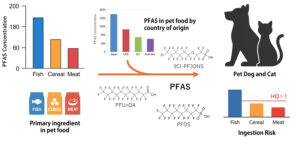
PFAS were frequently detected, particularly in fish-based products. Hazard quotient (HQ) calculations based on EFSA tolerable intake values exceeded 1 for several products, suggesting potential health risks to companion animals.
This study provides the first systematic large-scale evidence of ingredient-driven PFAS contamination in pet food and highlights the need for regulatory oversight and species-specific toxicological evaluation.
Details
Key Findings
-
Frequent detection of PFAS across products
Dry foods showed higher concentrations, whereas wet foods resulted in higher estimated daily intake due to larger feeding volumes. -
Fish-based ingredients as major contamination drivers
Products listing fish as the primary ingredient contained significantly higher ΣPFAS levels. Long-chain PFCAs such as PFUnDA and PFTrDA, as well as PFOS, were dominant. -
Country-of-origin specific PFAS patterns
PCA revealed clustering differences between Asian and U.S. products. The PFOS alternative F-53B–related compound (9Cl-PF3ONS) was detected in some Asian-manufactured products. -
Hazard Quotients exceeding 1
EFSA-based HQ estimates for the sum of four PFAS (PFOS, PFOA, PFNA, PFHxS) exceeded 1 in multiple products, especially wet food.
Publication Information
Journal: Environmental Pollution
Title: Widespread PFAS contamination in pet food: Dietary sources and health risks to companion animals
Authors: Kei Nomiyama*, Aika Sato, Rumi Tanoue, Kohei Saeki, Yoshinori Ikenaka, Hazuki Mizukawa
DOI: 10.1016/j.envpol.2026.127779
URL:
https://doi.org/10.1016/j.envpol.2026.127779